
2nd Geo-RIN Conference. Geothermal Research and Innovation Network for Spain and Portugal. March 2027
9 until 12 of march of 2027
The conference will be held in the beautiful São Miguel, the biggest island of the Azores, at UAc-University of the Azores - Campus de Ponta Delgada.
Its volcanic landscape offers a stunning natural setting for inspiration and collaboration.

9 until 12 of march of 2027
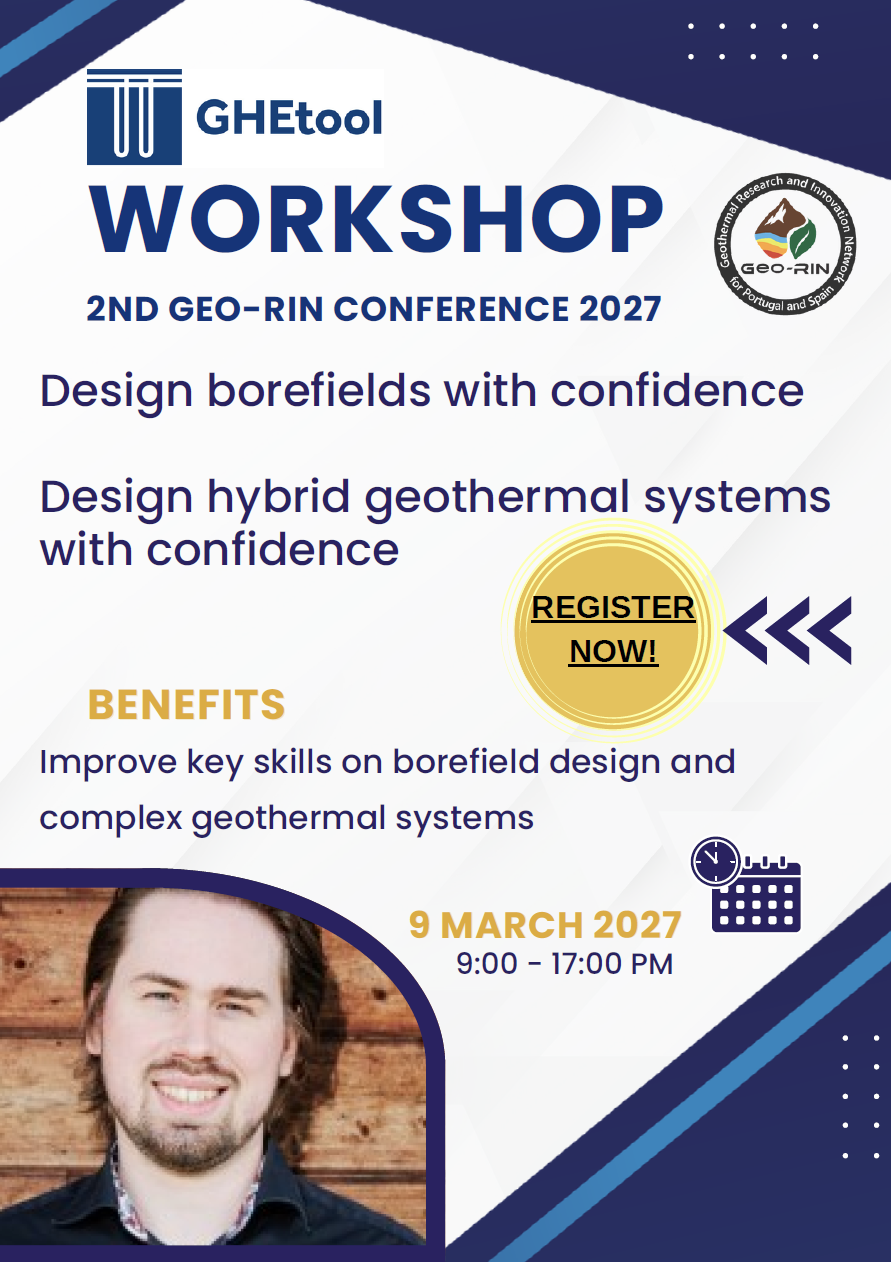
Design borefields with confidence Design hybrid geothermal systems with confidence BENEFITS Improve key skills on borefield design and complex geothermal systems LECTURER Wouter Peere
09-03-2027 09:00 until 09-03-2027 17:00 Optional
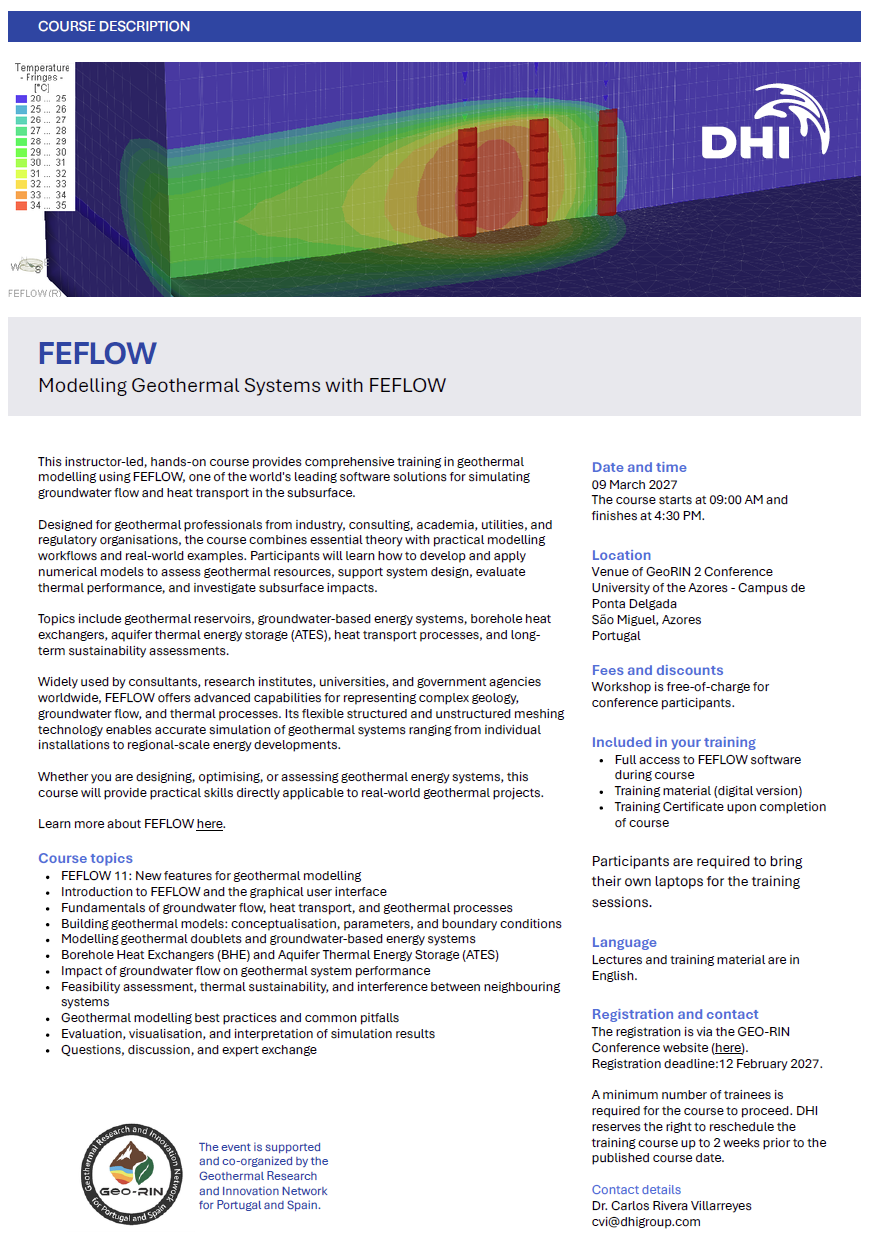
Modelling Geothermal Systems with FEFLOW LECTURER Dr. Carlos A. Rivera Villarreyes
09-03-2027 09:00 until 09-03-2027 17:45 Optional
Conference-Day1
10-03-2027 09:00 until 10-03-2027 17:30
Conference-Day2
11-03-2027 09:00 until 11-03-2027 17:30
Field trip
12-03-2027 09:00 until 12-03-2027 17:30
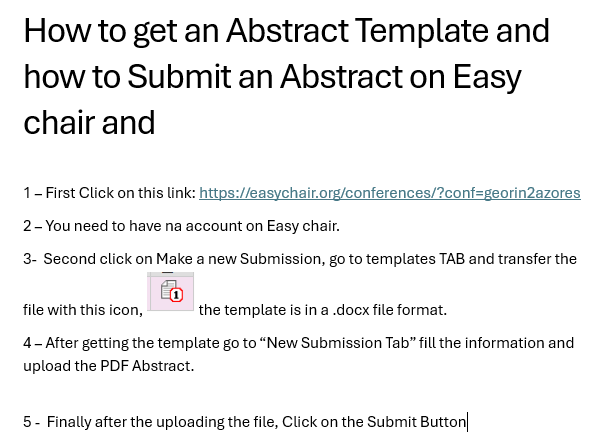
1 – First Click on this link: https://easychair.org/conferences/?conf=georin2azores
2 – You need to have na account on Easy chair.
3- Second click on Make a new Submission, go to templates TAB and transfer the file with this icon  , the template is in a .docx file format.
4 – After getting the template go to “New Submission Tab” fill the information and upload the PDF Abstract.
5 - Finally after the uploading the file, Click on the Submit Button
To support the organisation of Geo-RIN Azores 2027 and to strengthen collaboration between the geothermal community and industry, we have developed a range of sponsorship opportunities designed to provide valuable visibility and engagement for participating organisations.
Sponsors will benefit from direct exposure to a highly specialised audience, including researchers, consultants, technology providers, public administrations, investors and end users involved in geothermal development across Spain, Portugal and Europe. In addition to increasing brand visibility, sponsorship offers opportunities for networking, knowledge exchange and the establishment of new professional partnerships.
We would be delighted to welcome your organisation as a sponsor of Geo-RIN Azores 2027. The sponsorship opportunities available are outlined below.
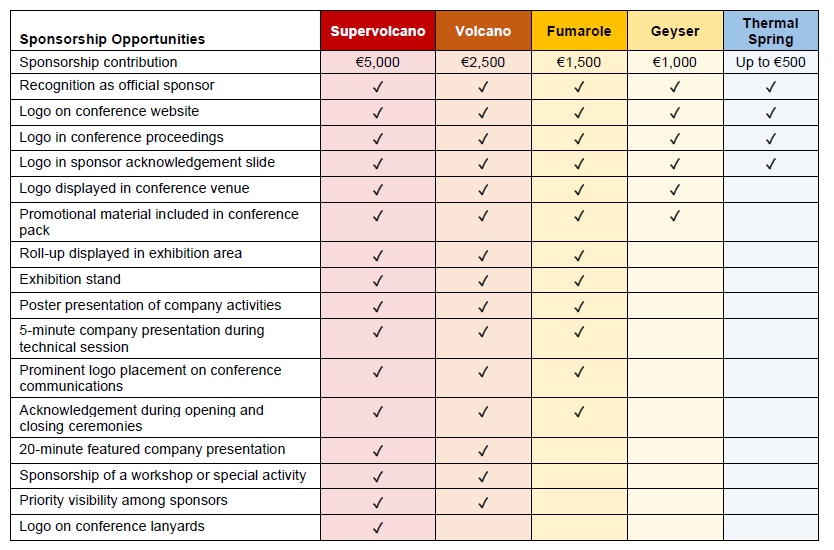
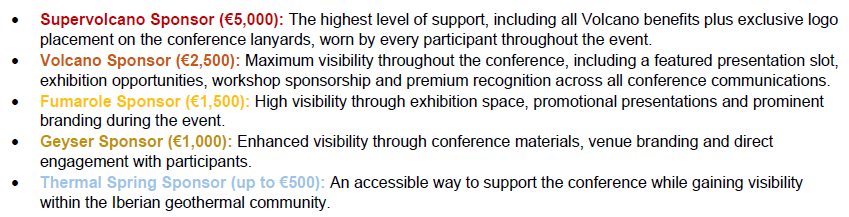
Tailored sponsorship packages are also available upon request. Organisations interested in sponsoring specific activities such as coffee breaks, the conference dinner, workshops, student grants, awards or other networking events are warmly invited to contact the Organising Committee.
We would be pleased to discuss any of these sponsorship opportunities and explore options that best align with your organisation's objectives. We look forward to the possibility of working together to make Geo-RIN Azores 2027 a success.
Please do not hesitate to contact us if you have any questions or would like to arrange a call.
FEFLOW
Modelling Geothermal Systems with FEFLOW
This instructor-led, hands-on course provides comprehensive training in geothermal
modelling using FEFLOW, one of the world's leading software solutions for simulating
groundwater flow and heat transport in the subsurface.
Designed for geothermal professionals from industry, consulting, academia, utilities, and
regulatory organisations, the course combines essential theory with practical modelling
workflows and real-world examples. Participants will learn how to develop and apply
numerical models to assess geothermal resources, support system design, evaluate
thermal performance, and investigate subsurface impacts.
Topics include geothermal reservoirs, groundwater-based energy systems, borehole heat
exchangers, aquifer thermal energy storage (ATES), heat transport processes, and longterm
sustainability assessments.
Widely used by consultants, research institutes, universities, and government agencies
worldwide, FEFLOW offers advanced capabilities for representing complex geology,
groundwater flow, and thermal processes. Its flexible structured and unstructured meshing
technology enables accurate simulation of geothermal systems ranging from individual
installations to regional-scale energy developments.
Whether you are designing, optimising, or assessing geothermal energy systems, this
course will provide practical skills directly applicable to real-world geothermal projects.
LECTURER: Dr. Carlos A. Rivera Villarreyes
Dr. Carlos A. Rivera is the Global Product Specialist and Business Owner for FEFLOW at DHI Group, where he is responsible for the strategic vision, business development, and long-term product direction of FEFLOW, one of the world's leading software solutions for subsurface flow and heat transport modelling. With more than 15 years of international experience in subsurface modelling, he has led and supported projects in geothermal energy, groundwater resources, mining, environmental applications, and reactive transport modelling.
Carlos combines extensive technical expertise with practical industry experience, supporting organizations worldwide in the application of numerical modelling for geothermal and groundwater challenges. He regularly delivers professional training courses, workshops, and conference presentations across Europe, the Americas, Asia, and Australia.
Education
- PhD, Hydrology, University of Potsdam, Germany
- MSc, Water Resources Management, Ben-Gurion University of the Negev, Israel
- BSc, Civil Engineering, University of Piura, Peru
DOWNLOAD: PDF pamphlet
DESIGN BOREFIELDS WITH CONFIDENCE
(4H WORKSHOP; 2H THEORY 2H PRACTICE)
In this workshop, you'll learn how to design your first borefield using GHEtool Cloud. We'll walk you through the required input parameters, the underlying borefield models and physics, and why flexibility in borefield design matters so much in practice. You'll
then apply this knowledge to a hands-on case study relevant to the Iberian Peninsula. This workshop is ideal both for those new to borefield design and for experienced designers looking to explore the latest methods and models.
DESIGN HYBRID GEOTHERMAL SYSTEMS WITH CONFIDENCE
(4H WORKSHOP; 2H THEORY 2H PRACTICE)
As projects grow more complex, relying solely on geothermal borefields is often no longer the optimal choice. Combining ground-source and air-source heat pumps, together with regeneration strategies such as dry coolers, is increasingly preferred. However,
designing these hybrid systems is complex and timeconsuming.
In this workshop, you'll learn everything you need to know about hybrid geothermal design and how GHEtool Cloud can support you, illustrated with real-life case studies. By the end, you'll have the confidence to tackle even the most advanced geothermal projects. Some prior experience in geothermal design (or having attended the first workshop) is recommended.
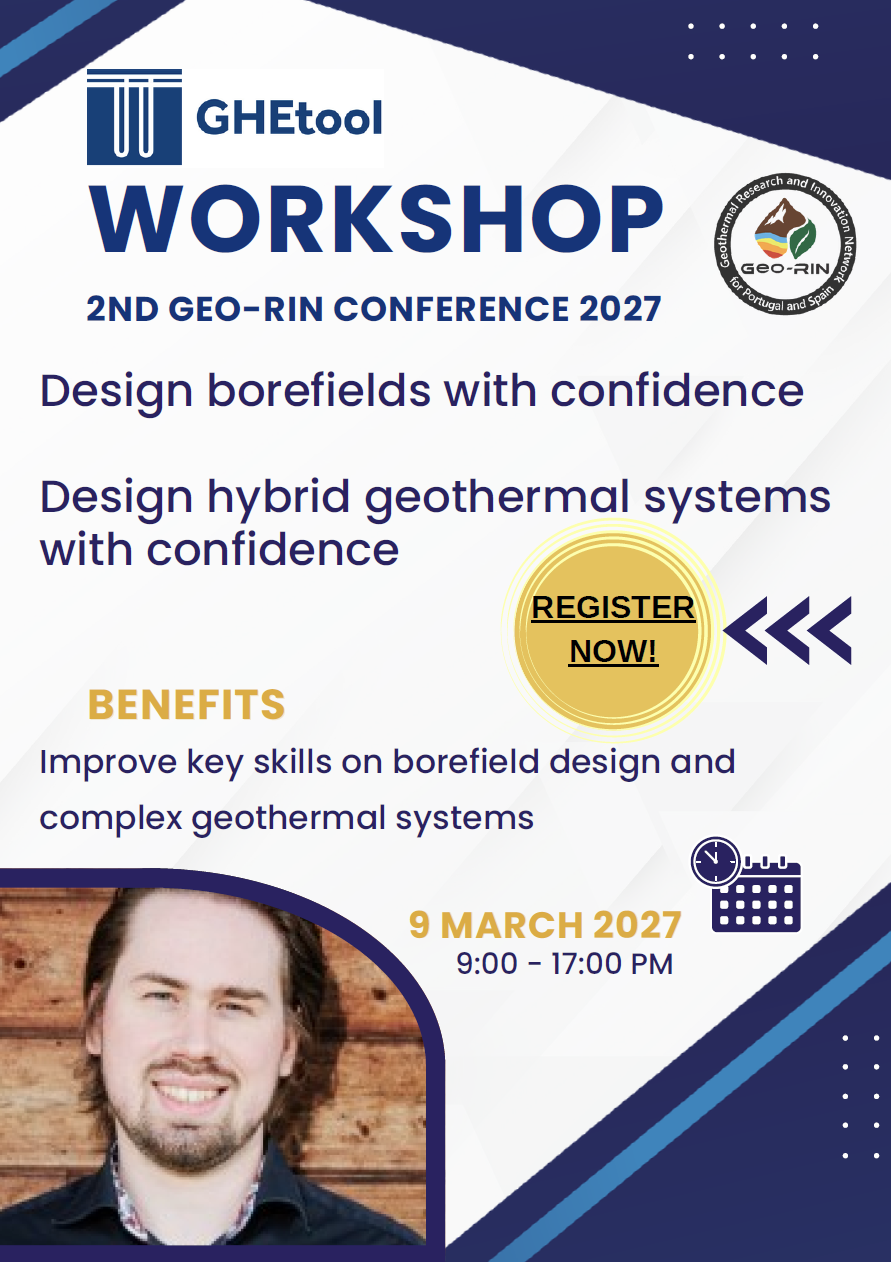
LECTURER: Wouter Peere
Wouter Peere graduated in 2020 as a mechanical engineer at the Catholic University of Leuven (Belgium) with a thesis on the topic of hybrid geothermal design. After a research period of 3 years at this university, in close collaboration with Boydens Engineering, he started his own engineering firm Enead. Since 2023, Enead is the main developer and distributor of GHEtool, a cloud-based borefield sizing tool for both small and complex geothermal systems, which currently has over 120 users in more than 10 countries.
BENEFITS: Improve key skills on borefield design and complex geothermal systems
DOWNLOAD: PDF pamphlet
Researchers and professionals are invited to submit two-page extended abstracts for oral and poster presentations through the following link:
https://easychair.org/conferences/?conf=georin2azores
Authors must have an EasyChair account to submit the same submission or create one.
Abstracts may be submitted covering, but not limited to, the following topics:
Shallow Geothermal Systems: Exploration and Characterization
How should a site for shallow geothermal energy projects be characterized? What methodologies have been proposed? From thermal response tests to temperature monitoring, including numerical modeling approaches and uncertainty analysis, this session will present the exploration methods used to characterize sites for shallow geothermal energy projects, as well as the results of that characterization.
Deep Geothermal Systems: Exploration and Characterization
The location, characterization, and sustainable management of deep geothermal resources require detailed, long-term surface studies. Discoveries and advances in resource exploration and characterization techniques will be highlighted in this session. This session will also address environmental aspects, impacts, monitoring, and the development of baselines for geothermal projects.
Geothermal and the Built Environment
What is the best way to integrate geothermal systems into the built environment? From architecture and the integration of geothermal energy into infrastructure design to district heating and cooling and thermal energy networks, this session aims to explore case studies and lessons learned on how geothermal energy can be integrated into the built environment and urban planning.
Heating & Cooling
Fifty percent of global energy demand is based on needs for heating and cooling in domestic and industrial settings. This session will discuss the activity and development in heating and cooling applications, market research and development, and heat customers. Contributions related to district heating and cooling systems and thermal energy networks are welcome to this session.
Conventional & Next-Gen Deep Geothermal Systems
This session brings together everything related to technology and innovation in the field of deep geothermal systems. From new drilling technologies to the development of AGS systems, this session aims to highlight ongoing research and practical applications in the field of conventional and next-generation deep geothermal systems.
Underground Thermal Energy Storage (ATES, BTES, CTES, MTES)
Underground thermal energy storage (UTES) offers great potential as a means of balancing seasonal heating and cooling demand for buildings and storing excess renewable energy at times of low demand. UTES systems are, if well designed, more efficient and cheaper to operate than traditional geothermal installations. However, UTES has not yet been widely adopted, and this is partly due to the need for a better understanding of the subsurface processes and approaches for geothermal site assessment. This track will highlight research underway and real-world applications to help advance UTES deployment.
Geothermal Applications & Synergies
Greenhouse heating and cooling, retrofitting of oil and gas wells for geothermal purposes, use of active and abandoned, flooded mines for geothermal heating and cooling, applications of geothermal resources to balneotherapy and space heating, and the use of geothermal brines as a source of critical raw materials are some of the aspects that will be addressed in this session.
The Social, Economic, and Political Side of Geothermal
This session aims to understand activities underway, under development, and the work still needed in social impact and governance, FPIC (Free, Prior, and Informed Consent), Resettlement Assistance plans (RAP), right to operate, managing expectations, social economics, and the language we use. At the end of the day, stakeholder engagement and good project communication at the community level is vital for the success of a project.
As developing and understanding financing, finance structures, finance sources, and the route to a project being finance ready is one of the most important aspects of any project, this session will look to provide insights on all things geothermal project economics including Public and Development Banks, Insurance and Risk Mitigation, Business Strategies and Models, LCOE, LCOH, PPA’s, PPPP’s IFC, financial due diligence, Overseas Assistance funds, and Venture Capital funding. This is a key aspect, as project economics is often the leading barrier to project development and deployment.
In addition, as robust policies and regulatory frameworks that support the development of geothermal projects are often lacking, this session will present those policies that work and those that are under development; regulatory activities that support development and the gaps that remain. This track will also explore areas that are open to standardisation for rapid and consistent development globally. Finally, stakeholder engagement and good project communication at the community level is vital for the success of a project. This track also aims to understand activities underway, under development, and the work still needed in social impact and governance, FPIC (Free, Prior, and Informed Consent), Resettlement Assistance plans (RAP), right to operate, managing expectations, social economics, and the language we use.
| ANTÔNIO TROTA | AZORES UNIVERSITY |
| MAFALDA MIRANDA | GRANALYTICS LTDA |
| RUI PIRES | GRANALYTICS LTDA |
| ELSA RAMALHO | LNEG |
| ANA VIEIRA | LNEC |
| JOÃO CARLOS NUNES | AZORES UNIVERSITY |
| ANTONIO FIGUEIREDO | AVEIRO UNIVERSITY |
| LUIS GOMES | BEIRA INTERIOR UNIVERSTIY |
| MARIA CARVALHO | LISBON UNIVERSITY |
| LUIS COELHO | IP SETUBAL |
| BRUNO PEREIRA | SINERGEO |
| PEDRO MADUREIRA | SYNEGE |
| JOÃO FIGUEIRA | GEOGRADIENT |
| LIGIA PINTO | LMPAA |
| GRAÇA RANGEL | EDAR |
| CRISTINA DE SANTIAGO | IGME |
| AYALA CONCEPTION | CSIC |
| ADELA ESCUDERO | DELFT UNIVERSITY |
| SILVIA DE SIMONE | CSIC |
| GEMMA MITJANAS | TERXPLORATION |
| BORJA BADENES | POLYTECHNIC UNIVERSITY OF VALENCIA |
The conference will be held in the beautiful São Miguel, the biggest island of the Azores, at UAc-University of the Azores - Campus de Ponta Delgada. Its volcanic landscape offers a stunning natural setting for inspiration and collaboration.
Organizing committee
antonio.pn.trota@uac.pt
mafalda.a.m.miranda@gmail.com