

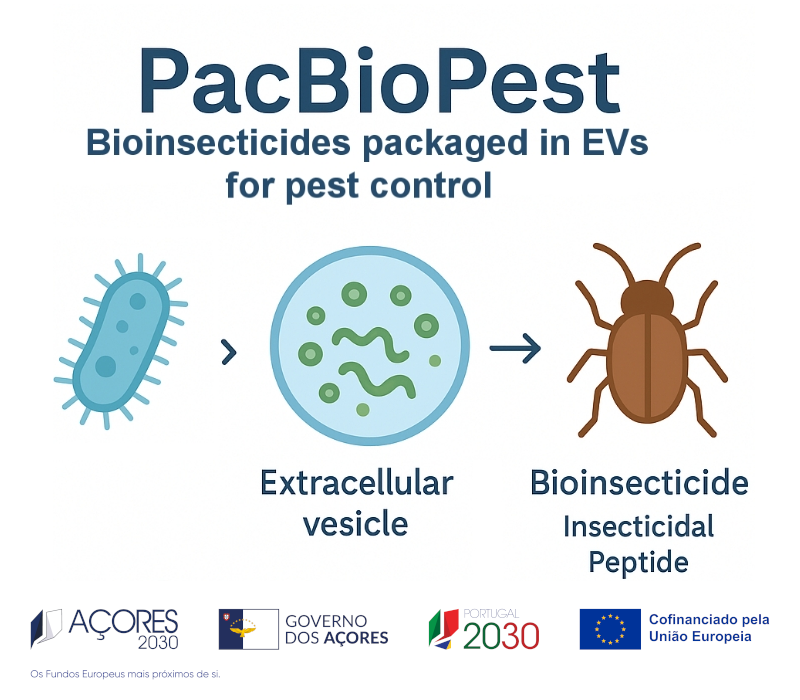
 Project PacBioPest

| Acronym: | PacBioPest |
| Cost Center: | 1320 |
| Operation Code: | ACORES2030-FEDER-02312800 |
| Title: | Exploratory Study of Bioinsecticides incorporated in extracellular vesicles for sustainable control of insects pest |
| Start-End: | 02-12-2025 - 01-12-2028 |
| Entidade Beneficiária Principal: | FGF - Fundação Gaspar Frutuoso, FP |
| Gestores da FGF: | Vera Cordeiro |
| Responsible Researcher: | Jorge Miguel Vieira de Frias |
| Organic Units: | FCT - Faculdade de Ciências e Tecnologia |
| R&D Units: | CBA - Centro de Biotecnologia dos Açores |

| Entidade | Montante |
|---|---|
| Total Financing | 160.740,00 € |
| Programa Regional AÇORES 2030 (FEDER) (85.0 %) | 24.111,00 € |
| PRO-SCIENTIA (ORAA) (15.0 %) | 136.629,00 € |
Main Objectives:
1. Produce and characterize insecticidal peptides derived from entomopathogenic nematodes (Steinernema carpocapsae).
2. Encapsulate the peptides in extracellular vesicles (EVs) using E. coli as a production platform.
3. Evaluate insecticidal efficacy against agricultural pests with great economic impact, such as: Drosophila suzukii (fruit fly); o Ceratitis capitata (Mediterranean fly); o Popillia japonica (Japanese beetle). o Potential for other agricultural pests
4. Test the environmental safety of bioinsecticides, ensuring the absence of toxicity in beneficial insects (e.g. Coccinella undecimpunctata and Trichogramma cordubensis) and in vertebrate cells.
5. Develop a laboratory prototype with a view to patenting and future licensing.
Project Description:
The PacBioPest project is co-financed by FEDER, through the Direção Regional do Planeamento e Fundos Estruturais under the Azores 2030 Program in 85% and in 15% by RAA through the Direção Regional da Ciência, Inovação e Desenvolvimento, through the PRO-SCIENTIA Incentive System.
The project aims to develop sustainable bioinsecticides using insecticidal peptides from entomopathogenic nematodes encapsulated in extracellular vesicles produced by bacteria in bioreactors. This innovative approach aims to replace chemical pesticides, offering an ecological, efficient and safe solution for controlling agricultural pests, protecting the environment, biodiversity and human health.